
In modern electronics manufacturing, product reliability isn’t a luxury—it’s the expectation. Every device that reaches a customer’s hands has already lived through a rigorous journey of validation, measurement, and verification. At the heart of that journey sits a critical piece of engineering infrastructure: the functional test system.
Today, we’re taking you behind the scenes of one such system—a compact yet powerful benchtop setup designed to ensure that complex electronic assemblies perform flawlessly before they ever leave the production floor.
What You’re Looking At
The test system shown above is a fully integrated benchtop functional tester built for precision, repeatability, and speed. It brings together several key components: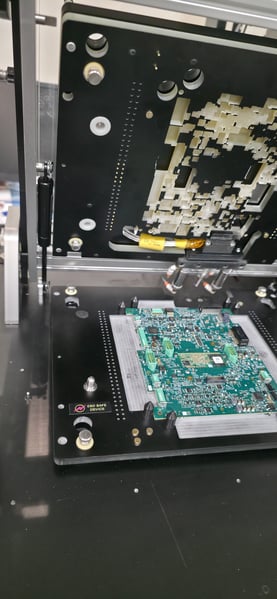
Custom Test Fixture
The centerpiece is a dedicated fixture engineered for a customer’s board. With hundreds of test points, labeled harnesses, and guided wiring, the fixture ensures consistent electrical contact and stable measurement conditions. Its design supports:
- High density probing
- Pneumatic actuation for more accuracy
- Repeatable mechanical alignment
- Fast operator workflow
- Safe handling (yes—sometimes it really does take two people!)
Instruments That Power the Test
A functional test system is only as good as the instruments behind it. This setup integrates a carefully selected suite of hardware, each chosen for precision, repeatability, and automation readiness.
Measurement System — Keithley DAQ6510
- Specification: 80 Channel DMM with 7708/7702 switching modules
- Purpose: High accuracy voltage, current, frequency measurement and impedance sensing across dozens of test points
Power Supply — Rigol DP832A (x2)
- Specification: Three channel DC power supplies
- Purpose: Providing stable 3.3V, 5V, 12V, and 15V rails to the DUT during functional evaluation
Relay Control — Advantech USB 5862 (x5)
- Specification: Isolated relay and digital input modules
- Purpose: Automated power sequencing, programmer routing, and RS 485 switching
Programming — Segger J Link Plus
- Specification: High speed embedded programmer
- Purpose: Sequential flashing of three auxiliary microcontrollers during the test cycle
Together, these instruments form a cohesive ecosystem that supports automated test scripts, consistent pass/fail criteria, and complete traceability.
Peripheral Simulation — Aardvark I²C/SPI Host Adapter
- Specification: USB controlled I²C/SPI master/slave interface
- Purpose: Simulating external peripherals and communication partners during functional testing, enabling the DUT to interact with controlled, repeatable I²C/SPI stimulus and responses
Integrated Control & Automation
The entire setup is orchestrated through automated test scripts, enabling:
- Consistent pass/fail criteria
- Automated logging and traceability
- Reduced operator variability
- Faster throughput
This combination of hardware and software transforms a complex testing challenge into a streamlined, repeatable process.
Why Functional Testing Matters
Functional testing is the final checkpoint before a product enters the world. It ensures that:
- Every board behaves exactly as designed
- Manufacturing defects are caught early
- Firmware and hardware interact correctly
- Customers receive a product they can trust
In industries like medical devices, automotive, aerospace, and industrial automation, this level of assurance isn’t optional—it’s essential.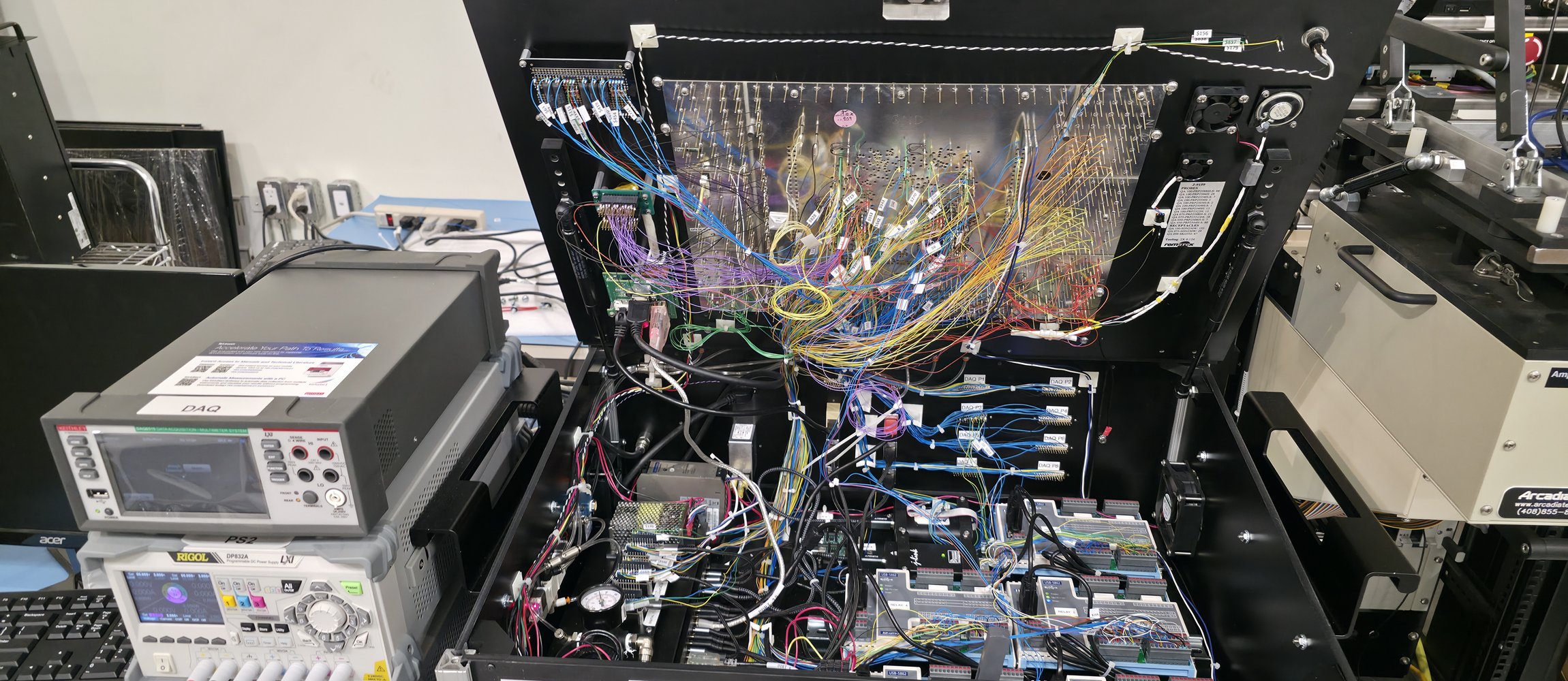
Built for Engineering Teams Who Demand Confidence
A benchtop system like this is ideal for:
- Manufacturing where flexibility and repeatability must coexist
- In process quality checks, ensuring assemblies meet requirements before final integration
- Service and repair operations, where fast, repeatable diagnostics reduce turnaround time
- In-system firmware programming, enabling automated flashing of multiple MCUs as part of the production workflow.
It delivers the rigor of a full production test station in a compact, flexible format.