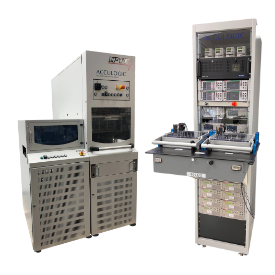
| With extensive experience in functional test equipment, a world-wide service and support organization, and a broad range of software/hardware options, we
will supply cost-effective production-ready test solutions to meet your test challenges. Proposals developed by our functional test engineering team include a detailed description of system
requirements, test instrumentation, estimated test cycle times (as applicable), footprint, and other key specifications.
Our solutions support a full range of PCB test applications that include in-line and end-of-line board and system level test. Field or depot test, diagnostics, and repair capabilities can
be readily added. Tracer 2000 test platforms offer a proven, reliable and cost-effective solution to most functional test problems.
A project approach to functional test development
Together with customer test engineers, a project manager is assigned to detail test and system specifications for each functional test project. Based on the specifications, instrument components,
test software environment, scalability of the design to support a variety of products, power distribution, floor-space limitations, ergonomic factors are decided. In addition to the specific
requirements, standard customer procedures and practices such as operator safety, security and access, graphic user interfaces, test reporting and output files, statistical process control
and other similar requirements are added to the deliverables. Finally, detailed specifications and clear delivery plans are outlined before manufacturing begins.
Tester availability
Intuitive graphical user interfaces together with comprehensive documentation allow operators to start production within hours after commissioning. Self-test routines and detailed documentation
also allow fast and efficient maintenance of the equipment by customer personnel. Ultimately these factors translate into longer MTBF, shorter MTTR, and therefore high equipment availability
at low cost.
Tester design
Software
Tester software is developed using LabWindows CVI™, Labview™, Visual C/C++, Visual Basic, and where appropriate, a combination of programming languages is utilized to develop the
graphic user interface (GUI) and the tests. In addition to managing various user interface in test development applications, software routines are employed mainly to initialize instruments,
set triggers, and configure instruments for proper stimulus, capture, and measurement modes. Finally individual tests are assimilated into a test sequence using a test executive software.
Hardware
Systems can be configured with VXI, PXI, GPIB, serial port, and PC based instrumentation to meet technical and budgetary requirements. Tester-fixture interfaces are chosen from among historically
tried and proven solutions. Depending on the project requirements, customers may choose MacPanel™, Virginia Panel™, VG2271™ style, or custom fixture interfaces which can
be developed with commercial or military connectors and suitable wire harnesses. The fixtures will be easy to use, and will guarantee low noise, and quick change over.
Self-test and tester diagnostics
All systems are supplied with self-test/self diagnostic capabilities and the documentation is provided in both paper and soft copy.
Documentation
Functional test systems are delivered with complete documentation facilitating rapid deployment and maintenance of the equipment.
Installation, Training and Technical Support
Acculogic functional test systems are delivered as true turnkey solutions. Training on system operation and maintenance is provided during installation and commissioning. Our application
engineering group supports the systems during warranty period. Long-term maintenance contracts are also available for life cycle system support.
Test Consulting Services
Acculogic offers consulting services to assist customers in developing production test strategies. These services can address product and process requirements ranging from a single board
to systems level testing. Alternatively, comprehensive inspection and test strategies can be developed based on the following technologies to address production, throughput, product mix, test,
budgetary and quality requirements:
- Inspection strategies
- Automatic optical inspection (AOI)
- X-Ray inspection
- In-Circuit or flying probe test
- JTAG (IEEE 1149.1) test
- Functional test
- A combination of inspection and test strategies
|